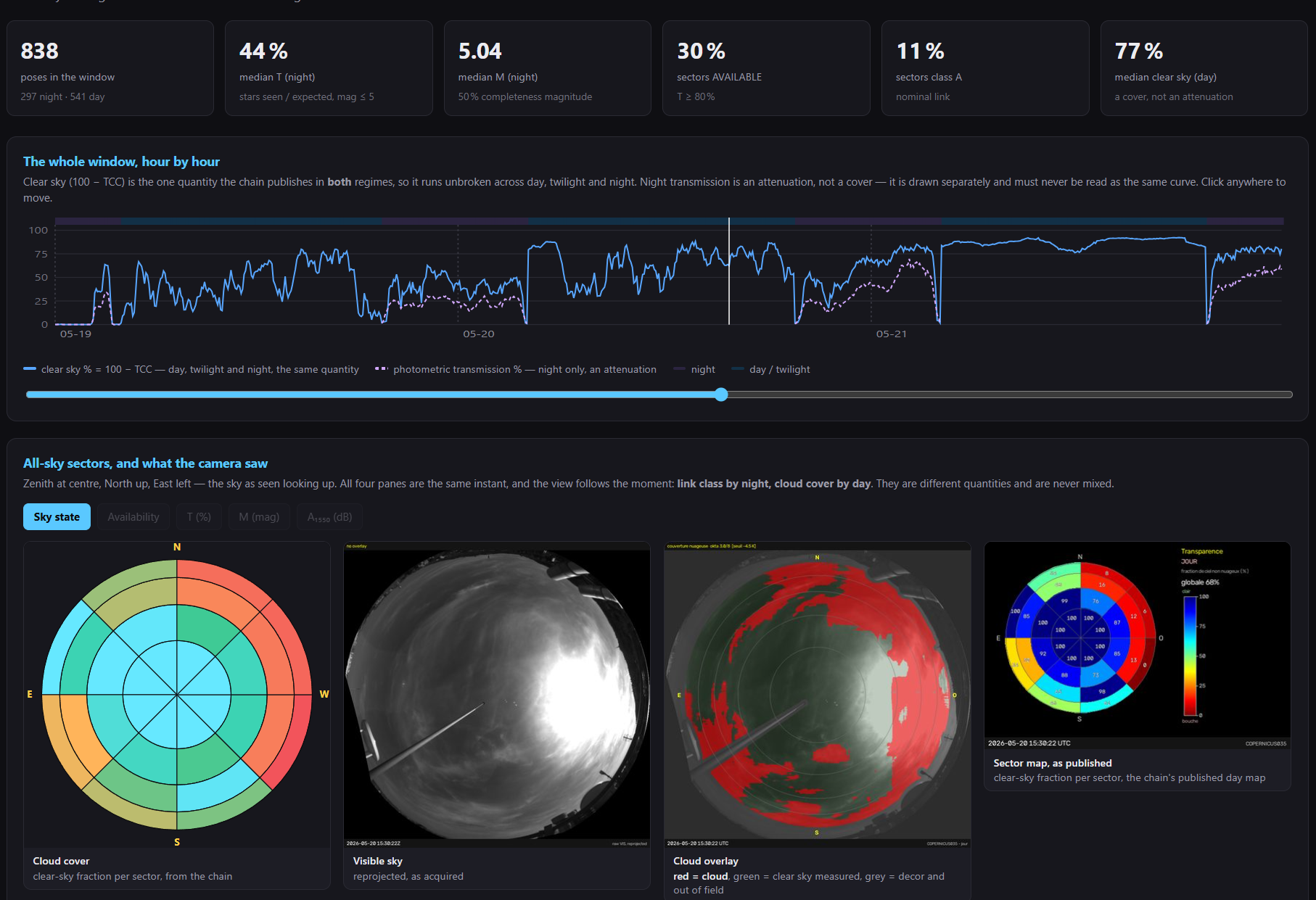
Miratlas already characterizes turbulence around the clock by combining complementary instruments. The DN-DIMM brings day and night together in a single instrument, with the same reference technique and no operator on site.
Miratlas presents the DN-DIMM (Day & Night Differential Image Motion Monitor) at the 16th International Conference on Space Optics (ICSO 2026, Sorrento, 12–16 October). The DIMM is the reference technique used to qualify the sites of the world's largest telescopes, but it has so far worked only at night. The DN-DIMM extends it to daylight: a single instrument now delivers the three link parameters around the clock, unattended. First deliveries to customers are planned for the first quarter of 2027.
One instrument, around the clock
As the radio spectrum saturates, laser communications are becoming critical infrastructure for LEO, MEO and GEO constellations. Their weak point is the atmosphere: turbulence, cloud cover, absorption and scintillation degrade link availability, sometimes to full outage.
Much of the industry still plans around atmospheric models. Miratlas already measures turbulence day and night with complementary instruments: the C-DIMM at night and the SHABAR by day. The DN-DIMM covers both with one instrument and one technique, producing a continuous, consistent series with no handover at dawn or dusk.
Three link parameters from one instrument
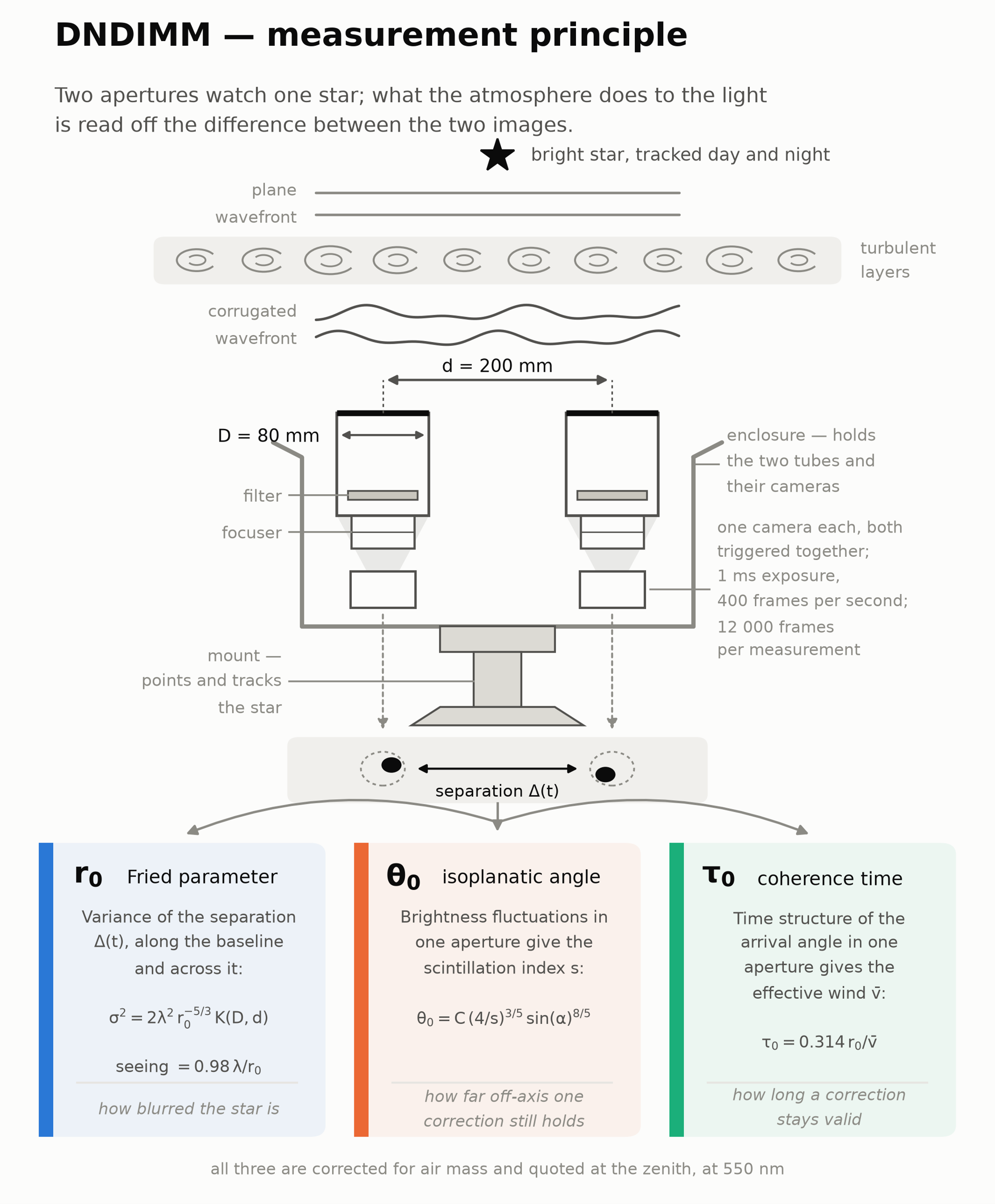
The DN-DIMM measures, through the whole air mass, the three parameters that drive optical link performance:
• the Fried parameter r₀: how much the atmosphere blurs the image;
• the isoplanatic angle θ₀: how far off-axis a correction remains valid;
• the coherence time τ₀: how long a correction remains valid.
All three are corrected for air mass, normalized to the zenith and reported at 550 nm.
" Operators plan their traffic and commit capacity to their customers around the clock. With the DN-DIMM, a single instrument shows them the real turbulence on their link, day and night, so they can choose the right station at the right time," said Jean-Edouard Communal, President and CEO of Miratlas.
Two telescopes instead of a mask
A conventional DIMM places a two-hole mask over a single telescope. The DN-DIMM uses two independent 80 mm telescopes, 200 mm apart, each with its own focuser. The extra light lets it work against a bright daytime sky: 1 ms exposures at 400 frames per second, and one measurement every 30 seconds built from 12,000 frames.
The image motion between the two channels gives r₀. Each channel on its own gives θ₀ and τ₀, with no third aperture needed.
First results over two summer months
The results presented at ICSO come from measurements taken by the DN-DIMM over two summer months in a Mediterranean environment, by day and by night.
The daily pattern repeats day after day. r₀ drops to 2.7 cm around 11:00 local time, peaks at 9.0 cm around 19:00, an hour before sunset, and settles between 5 and 6 cm at night. Median values over the period: r₀ of 4.94 cm (seeing of 2.30 arcseconds), θ₀ of 1.55 arcseconds and τ₀ of 3.65 ms.
Built to run unattended
The DN-DIMM operates outdoors, with no dome or building. A supervisor selects the star, points, centres, refocuses and recovers from faults on its own, and absolute encoders restore pointing after any interruption. Uptime depends on weather and star availability, not on staff. Its turbulence data is read alongside the cloud cover maps from the same Sky Monitor station, since clouds also decide link availability.
Part of the Lamarck atmospheric data layer
The DN-DIMM extends the Miratlas Sky Monitor suite, alongside the SHABAR (daytime turbulence profiling) and the C-DIMM (nighttime turbulence), which it can replace as an upgrade. Its data feeds Lamarck, a proprietary database of more than 20 TB collected by over 60 stations in 20 countries, growing by about 1 TB per month.
Since June 2026, Lamarck data is commercially available through the DataHub, via a web interface and an API. Satellite operators, space agencies and defence organizations use it to select ground station sites, spread stations for network resilience, and choose in real time the station with the best propagation conditions.
Availability
The DN-DIMM will be available during the first quarter of 2027, initially as an option and upgrade for the Miratlas Sky Monitor (ISM). It can replace the C-DIMM where customers choose it, while the C-DIMM remains the standard configuration.
About Miratlas
Founded in 2018 in Pertuis, France, by laser physicist Jean-Edouard Communal and telecommunications specialist Frédéric Jabet, Miratlas specializes in real-time atmospheric characterization for ground-to-space optical communications. Its Sky Monitor network and Lamarck database help satellite operators, defence agencies and optical infrastructure developers maximize link performance and reliability. Miratlas generates 95% of its revenue from exports, employs 17 people and is a regional winner of the French Tech 2030 program. Its partners include CNES, ESA, NICT, DLR and Orange.