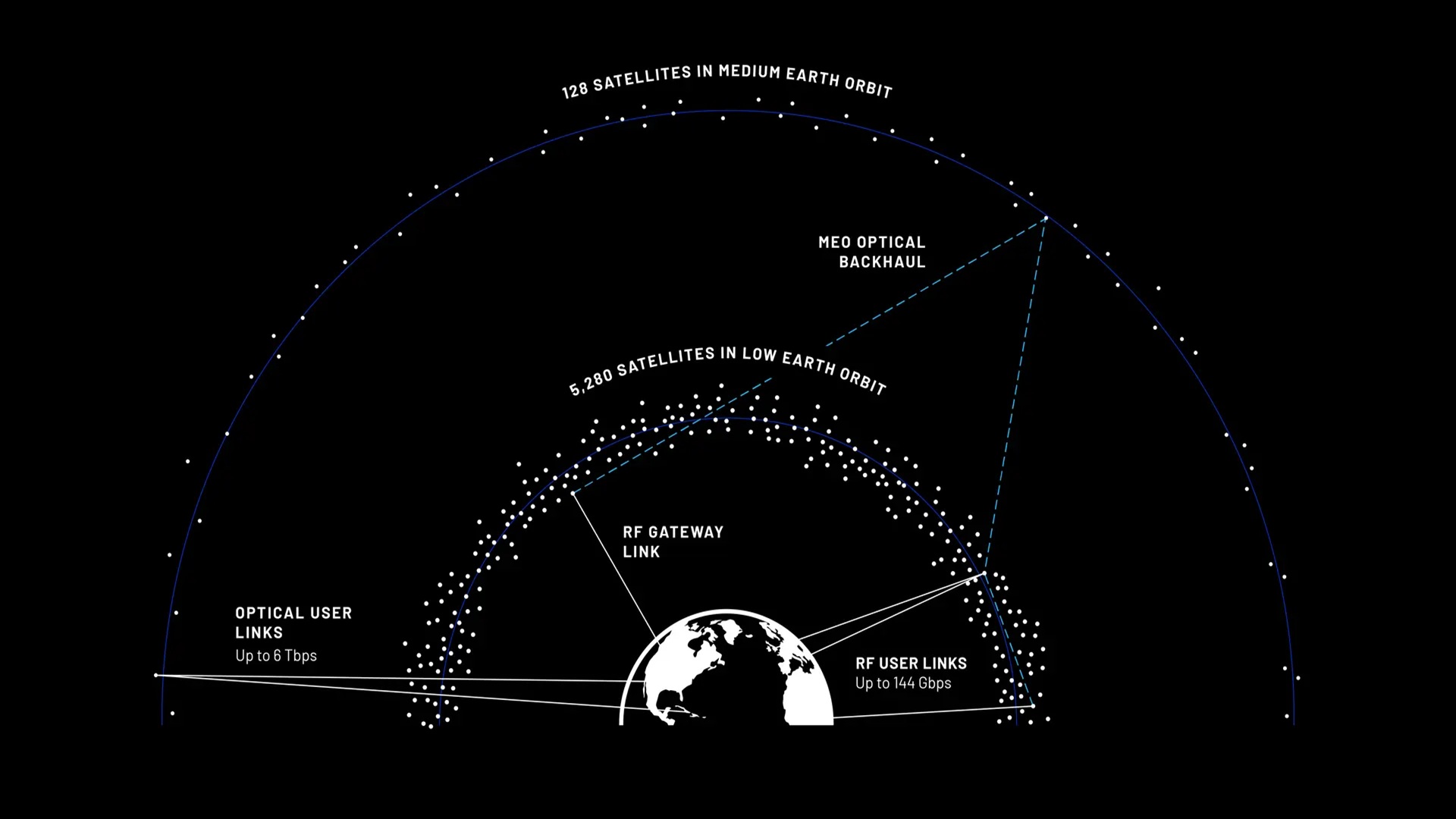
While the World Economic Forum in Davos captured the attention of international policymakers last week, Blue Origin announced the launch of TeraWave, a mega-constellation of ultra-high-speed space communications based on optical links, explicitly aimed at institutional, governmental, and critical functions. This announcement sends a strong strategic signal: industrial players are already structuring the sovereign digital infrastructures of tomorrow, at a pace far faster than public decision-making processes. This gap exposes Europe to a risk of long-term dependence and necessitates an immediate acceleration of political, industrial, and budgetary decisions.
Space Constellations: From a Commercial Market to Critical Infrastructure Until now, major telecommunications constellations have primarily targeted the consumer market. Starlink has established itself as the dominant player, with nearly 9 million users and over 9,000 satellites in orbit. Amazon is following a similar trajectory with Project Kuiper, whose first satellites were deployed at the end of 2025, aiming for a target constellation of over 3,200 low Earth orbit satellites.
Europe is not absent from this landscape. Eutelsat OneWeb operates a fully functional constellation and strengthens its European industrial base through launch agreements with MaiaSpace, for new deployments starting in 2027. This initiative directly contributes to European strategic autonomy. However, despite a more institutional positioning, the architecture and use cases remain close to existing commercial models.
China is also advancing rapidly, deploying multiple sovereign mega-constellations in low Earth orbit, notably Guowang and Qianfan, with stated objectives of tens of thousands of satellites, supported by the state and integrated into a broader strategy of digital sovereignty.
TeraWave represents a break. For the first time, a space constellation is designed from the outset as a high-level critical infrastructure, based on space optical links, targeting service continuity, resilience, cybersecurity, and full mastery of the technology chain. This positioning goes beyond commercial considerations: it directly impacts the strategic interests of states.
Space Communications: A Pillar of European Sovereignty
Space communications can no longer be considered merely a complement to terrestrial networks. They have become a structuring pillar of European sovereignty, on par with energy, semiconductors, or cloud infrastructure. The rise of multi-orbit architectures, the widespread demand for secure ultra-high-speed connectivity, and the maturity of optical technologies are transforming these networks into strategic assets.
Recent experience with Starlink has highlighted the vulnerability associated with relying on critical infrastructure controlled by non-European actors. TeraWave’s focus on sensitive use cases reinforces this observation. Europe must equip itself with sovereign capabilities, designed, operated, and governed according to its own political, regulatory, and security requirements.
An Already Structured European Industrial Capacity Europe has a clear historical precedent. Confronted with American dominance in aerospace, it created Airbus in 1970 through strong political will, coordinated public investments, and structured industrial cooperation. The same logic guided major European space programs: Ariane in the early 1970s, Galileo in the late 1990s, and Copernicus in the mid-2000s, each addressing a strategic sovereignty imperative.
Today, a complete industrial and technological ecosystem is in place for space optical communications. Companies such as Miratlas, Cailabs, Safran, Thales Alenia Space, and Airbus Defence and Space, closely linked with European laboratories and research, master the critical building blocks: ground-to-space optical links, atmospheric characterization, dynamic link supervision, system integration, and end-to-end security. The technological conditions for sovereignty are met.
Accelerate: A Political and Budgetary Imperative European programs such as IRIS², Moonlight, and EuroQCI provide solid foundations. However, the challenge is no longer technological demonstration but the rapid transition to large-scale operational infrastructure. As in artificial intelligence, the difference will lie in execution speed, governance clarity, and the scale of investments deployed.
Space optical communications have now become a structuring political choice for the European Union. They determine Europe’s ability to ensure the continuity of its critical functions, secure its sensitive data, and preserve its strategic autonomy in an increasingly constrained geopolitical environment. The alternative is clear: control these infrastructures or remain dependent on them.